Picking up a mooring is one of the first skills new boat owners need, and one of the most watched. Everyone in the bay seems to look up just as you miss the buoy for the third time. The manoeuvre itself is simple: arrive at the buoy at walking pace or slower, pointing into whatever is moving you, and have someone ready with a boat hook. This guide follows the advice in the Maritime Safety Victoria and South Australian boating handbooks and adds practical tips for making it routine.
Slowly
Approach speed
Maritime Safety Victoria
Into it
Approach direction
Into the wind or against the tide
Bow cleat
Where the line goes
Secure the line or chain forward
Before you approach
Get the boat and crew ready well before you reach the mooring field:
- Brief the crew: who steers, who picks up, how you'll signal and what happens if you miss.
- Put the boat hook where the person on the bow can reach it.
- Clear the foredeck of anything that could trip someone or snag the line.
- Have a spare line ready in case the mooring's pick-up line is short or damaged.
- Slow right down as you enter the mooring field, keeping wash to a minimum.
Agree on simple hand signals. Shouting over engine noise rarely works. Pointing at the buoy, holding up fingers for distance, and a raised fist for "stop" are enough.
Work out what's moving you
Maritime Safety Victoria's advice is to observe the wind and tidal flow before approaching a mooring. It also warns not to take other boats' positions as a guarantee of wind and current. Some boats lie in the opposite direction to the wind or current, because the wind's effect at the surface can be different from the general tidal flow, and different hull shapes react differently. A deep keel yacht may lie to the tide while a high-sided motor cruiser lies to the wind.
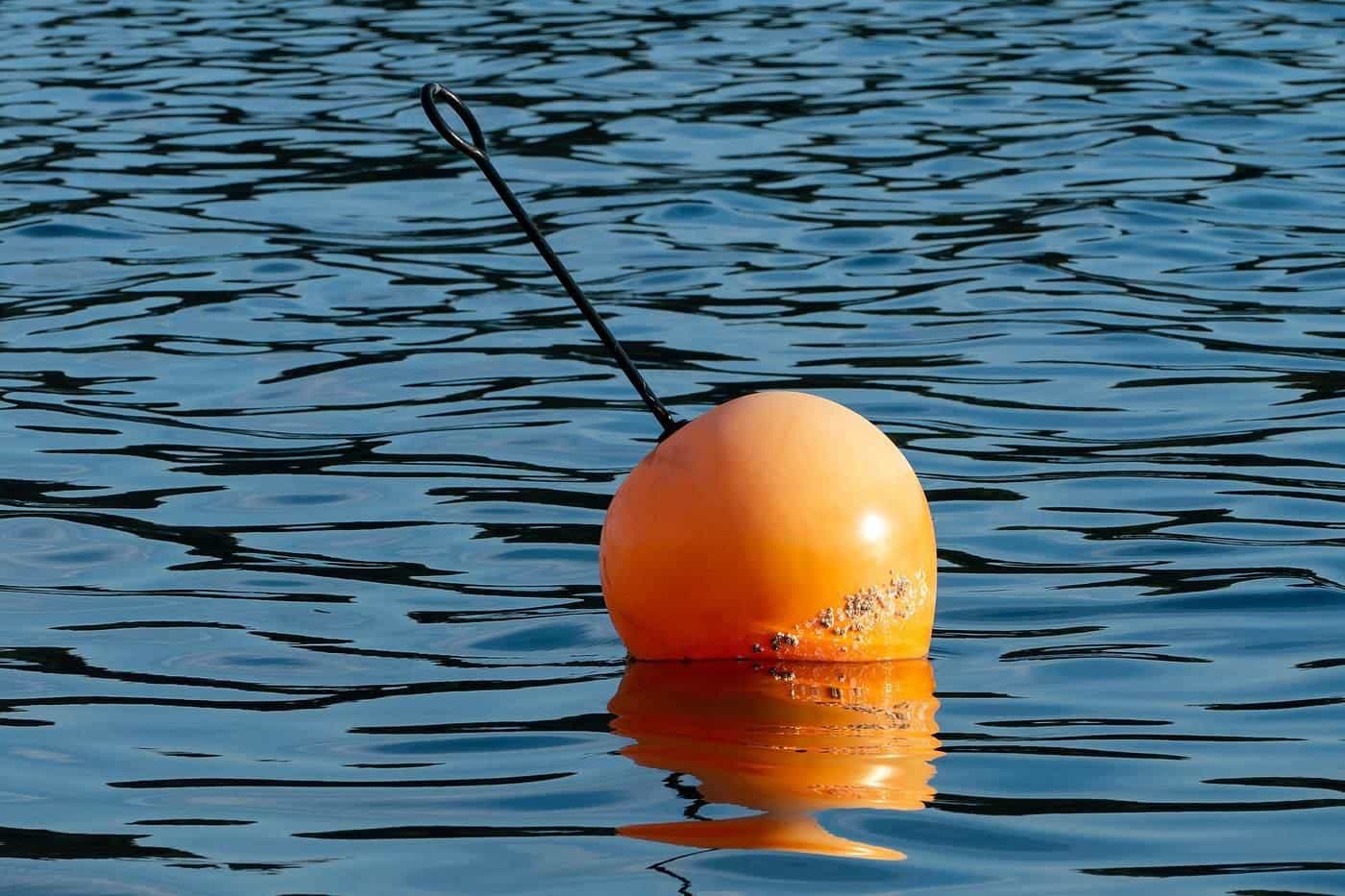
The small pick-up buoy is a useful indicator: watch which way it trails from the main buoy. That shows the direction of drift.
The approach
Maritime Safety Victoria and the SA handbook give the same sequence:
- Travel slowly.
- Approach into the wind or against the tide, using the stronger of the two as a brake.
- Don't overrun the mooring buoy. Running over it risks fouling the propeller on the mooring lines.
- Use a boat hook to capture the pick-up buoy.
- Secure the line or chain to a bow cleat.
Aim to stop with the buoy just off the bow, on the side where the person picking up is standing. On many boats the skipper loses sight of the buoy under the bow in the last few metres, so the person on the bow should point at it continuously.
Use short bursts of gear rather than holding the boat in forward. If the boat is getting too close too fast, a brief touch of reverse will stop it. If you're not going to make it, abort early, circle round and try again; there's no prize for getting it first time.
Picking up
Once the buoy is alongside the bow:
- Hook the pick-up buoy or the line beneath it, not the main buoy.
- Lift the line aboard, hand over hand, keeping fingers clear of the cleat and fairlead.
- Lead the line through the bow fairlead or roller and secure it to the bow cleat.
- Tell the skipper when the boat is secure, then put the engine in neutral.
If the wind or current takes the boat before the line is cleated, let go of the boat hook rather than being pulled overboard. A lost boat hook is cheaper than a person in the water.
Picking up under sail
Yachts can pick up a mooring under sail, but it takes practice. The principle is the same: approach slowly, heading into the wind, so the boat stops as the sails lose drive. In tidal waters, think about whether the tide or wind will dominate. Many skippers drop or furl the headsail before approaching and use the engine as a backup. Practise in quiet conditions first.
Once you're on the mooring
- Check that the boat is lying comfortably and isn't too close to neighbouring boats as it swings.
- Make sure the mooring line isn't chafing on the bow or stem; add chafe protection if needed.
- If you're staying aboard, check again when the tide turns.
- Lock up and leave the tender somewhere safe if you're going ashore.
Leaving a mooring
Maritime Safety Victoria's steps:
- Warm up the engine, or prepare the sails if sailing.
- Check for other boats nearby.
- Travel slowly, and keep passengers and crew within the boat, not on the side decks or bow, where they could block your view or be hurt.
- If there's heavy strain on the mooring, relieve it by using the motor or sails to come up to it.
- Release the chain or rope from the bow cleat, and drift back to clear the buoy before moving away. As you drift, check for trailing ropes that could catch in the propeller.
Only engage gear once the buoy and its lines are clear of the boat. Look over the side to be sure.
Common mistakes
- Approaching downwind or down-tide. The boat keeps moving after you reach the buoy, and you overrun it.
- Too much speed. If it feels slow, it's probably about right.
- Losing sight of the buoy. Agree signals with the person on the bow.
- Hooking the wrong part. Go for the pick-up buoy or the line under it.
- Driving over the line. If the buoy disappears under the boat, put the engine in neutral immediately.
- Leaving lines in the water. A floating line around the propeller can disable the engine.
Picking up someone else's mooring
Private moorings belong to their licence holders. Don't pick up someone else's mooring without permission, even for a short stop. The gear may not be rated for your boat, and the owner may return. Some waterways have public courtesy moorings with time limits; follow the rules on the buoy or signs.
Practising
Practise in quiet conditions, on a mooring with plenty of space around it. Try approaches with the wind and tide coming from different directions, and swap roles so everyone aboard learns both steering and picking up. A spare fender or a small buoy on a weighted line makes a good practice target away from other boats. Short, regular practice sessions build confidence faster than an occasional long one, and they make the real thing feel routine when the bay is busy and everyone is watching.
Key points
- Watch the wind, tide and pick-up buoy before you approach.
- Approach slowly into the wind or against the tide, whichever is stronger.
- Don't overrun the buoy; you risk fouling the propeller.
- Hook the pick-up buoy and secure the line to a bow cleat.
- When leaving, drift back clear and check for trailing ropes before engaging gear.
Frequently asked questions
Which direction should I approach a mooring from?
Into the wind or against the tide, using whichever is stronger as a brake. Maritime Safety Victoria warns not to rely on how other boats are lying, as different boats may lie differently.
What is the pick-up buoy for?
It is the small buoy attached to the mooring line that you catch with a boat hook. Maritime Safety Victoria notes it also shows the direction of drift.
What should I avoid when picking up a mooring?
Don’t overrun the mooring buoy. Running over it risks fouling your propeller on the mooring lines.
How do I leave a mooring safely?
Warm up the engine, check for other boats, motor up to relieve strain on the line, release it from the bow cleat and drift back clear of the buoy, checking for trailing ropes before you engage gear.
Where should crew stand?
Maritime Safety Victoria advises keeping passengers and crew inside the boat rather than on the side decks or bow when leaving, where they can block your view or be hurt.
Sources and further reading
Facts on this page were checked against these primary and official sources. Conditions change — confirm before you travel or buy.
- Mooring — Maritime Safety Victoria
- SA Boating Safety Handbook, chapter 8: Anchoring, mooring and berthing (PDF) — Department for Infrastructure and Transport SA
- Private Mooring Licence Conditions (PDF) — Transport for NSW